Is an MBA Worth It at a Low CAT Percentile? What 197 Colleges’ Fees and Salaries Show
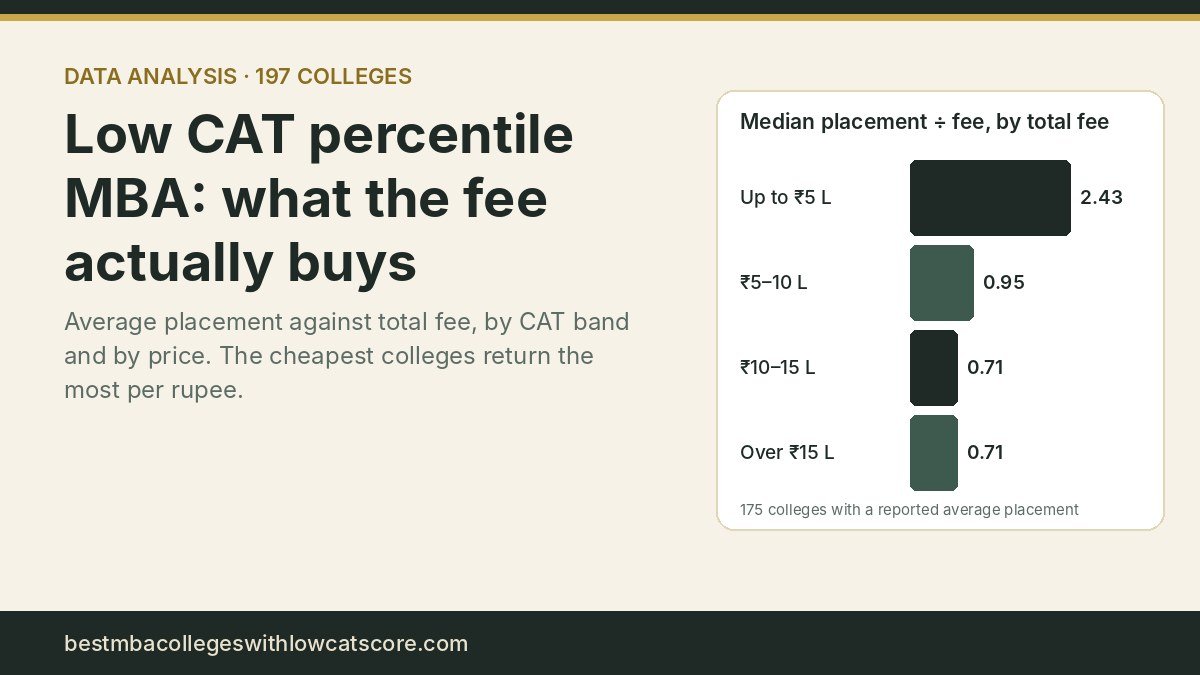
It can be, but the fee decides more than the percentile does. Across the 175 colleges in our directory that report an average placement, salaries climb steadily with the CAT band, from a median of 5.2 LPA where admission starts in the 40s to 17.2 LPA at 90-plus. Fees climb just as fast, so the placement-to-fee ratio barely moves between the 50s and the 80s. The real dividing line is price: colleges charging up to ₹5 lakh return a median 2.43 rupees of first-year salary per rupee of fee, against 0.71 for those charging more than ₹10 lakh.
Salary rises with percentile. So does the fee.
We grouped colleges by where their CAT band starts: a college admitting at 55–70 percentile sits in the 50–59 group. For each group we took the median total fee, the median reported average placement, and the median ratio of the two.
| Band starts at (%ile) | Colleges | With placement data | Median total fee | Median avg placement | Median placement ÷ fee | Fee in months of salary |
|---|---|---|---|---|---|---|
| 40–49 | 29 | 22 | ₹2.9 L | 5.2 LPA | 1.46 | 8 |
| 50–59 | 59 | 50 | ₹8.5 L | 7.4 LPA | 0.83 | 14 |
| 60–69 | 35 | 34 | ₹9.9 L | 8.2 LPA | 0.84 | 14 |
| 70–79 | 31 | 31 | ₹11.5 L | 10.0 LPA | 0.84 | 14 |
| 80–89 | 29 | 24 | ₹16.4 L | 13.1 LPA | 0.74 | 16 |
| 90+ | 14 | 14 | ₹19.1 L | 17.2 LPA | 0.90 | 13 |
Read across the middle four rows and the pattern is plain. Moving from a 50s college to an 80s one roughly doubles the fee (₹8.5 lakh to ₹16.4 lakh) and lifts the median placement from 7.4 to 13.1 LPA. The ratio stays between 0.74 and 0.84 the whole way. A higher percentile opens better-paid jobs, but in this tier you largely pay for them up front.
The 40s row breaks the pattern, with a median ratio of 1.46. That is not because weaker candidates earn more. It is because the group is full of state-university departments charging ₹1–3 lakh. Most of them fill seats through a state test, which is the catch we come to below.
The line that matters is price
| Total fee | Colleges | Median fee | Median avg placement | Median placement ÷ fee | Fee in months of salary |
|---|---|---|---|---|---|
| Up to ₹5 lakh | 37 | ₹2.7 L | 6.0 LPA | 2.43 | 5 |
| ₹5–10 lakh | 55 | ₹8.0 L | 7.4 LPA | 0.95 | 13 |
| ₹10–15 lakh | 45 | ₹12.9 L | 8.8 LPA | 0.71 | 17 |
| Over ₹15 lakh | 38 | ₹19.1 L | 15.1 LPA | 0.71 | 17 |
Two things jump out. First, going from ₹5–10 lakh to ₹10–15 lakh adds only about 1.4 LPA to the median placement, while the median fee rises by about ₹4.9 lakh. Second, above ₹10 lakh the ratio stops falling: the colleges charging more than ₹15 lakh do earn back their premium, because their placements are much higher too. They also sit in the 80–90-plus bands, so they are rarely open at a low score anyway.
For a candidate in the 50–70 range, the practical reading is this: a ₹12 lakh private college needs to show you a placement figure well above its cheaper neighbours to justify the difference. Several in our directory charging roughly ₹11–20 lakh in that band report averages of ₹4–8.5 LPA, which is no better than colleges at half the price. Ask for the placement report, not the brochure’s highest package.
Where the best value actually sits, and the catch
These are the ten colleges with the highest placement-to-fee ratio among those whose CAT band starts below 70 percentile.
| College | City | CAT band (%ile) | Total fee | Avg placement | Placement ÷ fee | Admission route |
|---|---|---|---|---|---|---|
| FMS MSU Baroda | Vadodara | 40–55 | ₹0.8 L | 7.3 LPA | 9.12 | CMAT; state test: GCET |
| BK School | Ahmedabad | 40–55 | ₹0.8 L | 5.1 LPA | 6.37 | CMAT; state test: GCET |
| AMU Aligarh | Aligarh | 60–75 | ₹1.0 L | 6.0 LPA | 6.00 | CAT only |
| BBAU Lucknow | Lucknow | 50–65 | ₹1.0 L | 5.0 LPA | 5.00 | state test: CUET-PG |
| DoMS Anna University | Chennai | 40–55 | ₹1.4 L | 6.0 LPA | 4.29 | MAT; state test: TANCET |
| University of Lucknow | Lucknow | 50–65 | ₹1.2 L | 5.0 LPA | 4.17 | state test: CUET-PG |
| MMMUT Gorakhpur | Gorakhpur | 50–65 | ₹1.5 L | 5.5 LPA | 3.67 | state test: CUET-PG, UPTAC |
| PUMBA | Pune | 60–80 | ₹3.0 L | 9.4 LPA | 3.13 | XAT, CMAT, MAT, ATMA; state test: MAH-CET |
| DIEMS | Aurangabad | 40–50 | ₹1.6 L | 4.0 LPA | 2.50 | CMAT, ATMA; state test: MAH-CET |
| Invertis | Bareilly | 40–55 | ₹3.0 L | 7.3 LPA | 2.43 | MAT, CMAT, XAT; state test: CUET-PG |
Eight of the ten are government or university departments, and most admit largely through a state or central test rather than CAT: GCET in Gujarat, TANCET in Tamil Nadu, MAH-CET in Maharashtra, AP-ICET in Andhra Pradesh, and CUET-PG or UPTAC in Uttar Pradesh. A CAT score alone may not get you a seat. Our state entrance test guide lists each test and its calendar. If you live in one of these states, sitting its test is the single cheapest thing you can do to improve your MBA’s return.
For a ranked view of every college by this ratio, see the MBA ROI index. For the cheapest options by fee ceiling, see MBA under ₹2 lakh and MBA colleges under ₹5 lakh.
So, is it worth it for you?
The data cannot answer that for any one person, but it does suggest a way to decide.
- If you can reach a state-university department through a state test, that is the strongest value in the data. Fees of ₹1–3 lakh with placements of 5–7 LPA are common.
- If you are choosing between private colleges in the 50–70 band, compare on ratio, not prestige. Below about 0.6, the college should be able to tell you why: a metro location, a specialisation or a recruiter you specifically want.
- If the fee is borrowed, count the months. A college whose fee equals 18 months of its average placement is a very different bet from one at 6 months, especially before tax, rent and loan interest.
- If none of your options clears the bar, waiting a year is a legitimate choice. A second attempt at CAT, or one more exam this cycle, can move you into a better band. XAT registration is open until 6 December; see the colleges that accept XAT.
Fees are also moving. Our note on MBA fee increases in 2026 shows where they are rising fastest. Before you commit, plug your expected score into the CAT college predictor to see which of these colleges are realistic for you.
Frequently asked questions
Is an MBA worth it with a low CAT percentile?
It can be, if the fee is low relative to the placement. In our directory, colleges charging up to ₹5 lakh return a median 2.43 rupees of first-year salary per rupee of fee; colleges charging over ₹10 lakh return about 0.71.
What salary can I expect from an MBA college that accepts 50–60 percentile?
Colleges whose CAT band starts in the 50s report a median average placement of 7.4 LPA in our directory, with a median total fee of ₹8.5 lakh. Individual colleges vary widely.
Does a higher CAT percentile mean a better return on an MBA?
Not in this tier. Placements rise with the band, but fees rise in step, so the median placement-to-fee ratio stays between roughly 0.7 and 0.85 from the 50s to the 80s.
Which MBA colleges give the best return for a low CAT score?
Government and state-university departments, such as FMS MSU Baroda, BK School Ahmedabad and DoMS Anna University, show the highest placement-to-fee ratios. Most admit largely through a state entrance test.
Are reported MBA placement figures reliable?
They are self-reported by institutes and not independently audited. Ask for the full placement report, including how many students were placed and the median, not just the average or highest package.
Before you pay anything: check that the college is AICTE-approved and know the refund rules.
Want colleges ranked by value for your own percentile? Get your free shortlist →
Sources & methodology
All figures come from this site’s directory of 197 MBA colleges (data verified 4 September 2026). Placement-to-fee ratio is the institute’s reported average placement in lakh per annum divided by its total two-year fee in lakh. Colleges are grouped by the lower end of their CAT band. Medians are used throughout so that a few outliers do not skew the picture. Fees are total two-year programme fees excluding hostel, as listed in this site’s college directory (data verified 4 September 2026). Add hostel, mess and exam costs before comparing, and confirm the current fee in the institute’s admission brochure before you pay anything.